Momentum Picking Up on Interim Legislative Studies

*A new tab has been added to the right side of the menu on the blog site: NDACo Interim Committee Tracking List. This list includes the committees, links to the committees and the studies that impact counties. As you can see by the list there are many committees with studies and reports that will be important to follow and participate in during the interim.

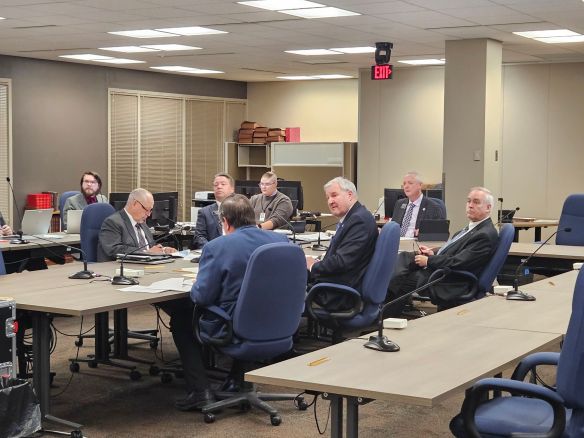
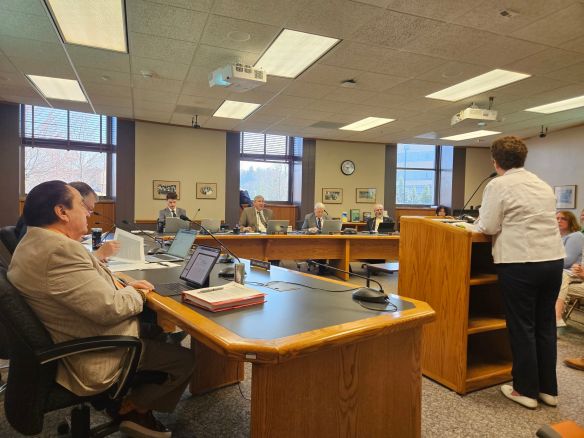
Most recently, NDACo provided testimony to the Tax Reform and Relief Advisory Committee which is studying the impacts of HB 1176 which was the major property tax relief bill that included budget limitations for local taxing districts. The committee will spend time looking at the relief provided, the impacts of the 3% cap on local government and the implementation of the various elements of this legislation. You can hear the committee discussion here: Tax Reform & Relief Advisory Committee Meeting 9-23.

It’s also important to highlight the creation of a new interim committee that will be fast-tracked to provide input to the Department of Health and Human Services regarding the state’s application for a federal rural health transformation grant. The state could be eligible for $100 million per year for five years but first has to apply for the money. The interim committee will work on legislation and possibly identify programs to invest those dollars in. It is very likely a special session will be held at the beginning of 2026 to appropriate the federal funds. The Rural Health Transformation Committee is made up of 34 members and hold their first meeting on October 14th & 15th.

NDACo Presents Legislative Wrap Up Report and Resources

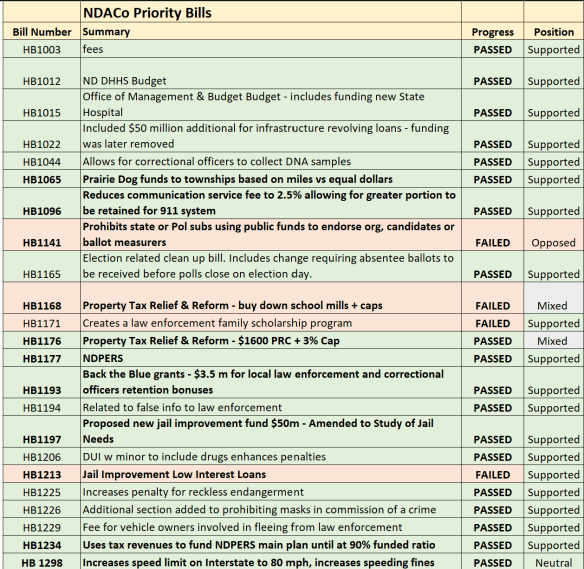
This week more than 400 county officials and employees participated in the NDACo Legislative Wrap Up report online. The good news is if you missed it – you aren’t missing out on the information. We have included those resources here for you to review when you have time. Included in this blog post is a list of the NDACo Priority Bills, the presentation slides provided and a recording of the wrap up report.

In all 1,089 bills were introduced during the 69th Legislative Session. Of those, NDACo tracked over 600 bills that had some relation or impact to county government.

Again, we appreciate our county folks’ involvement during the session through legislative committees, contacting legislators and providing testimony. Your engagement makes a difference!

View the Recording of the NDACo Legislative Wrap Up Report here

View NDACo Wrap Up Presentation Slides here

View list of NDACo Priority Bills here

Up Next… NDACo is teaming up with our political subdivision partners in providing a training on implementing Caps (HB 1176) June 16th 1-4:30. The training will be held in Bismarck at the BPS Career Academy, virtually and will be recorded as well. More information coming soon.

69th Legislative Session Ends over Weekend

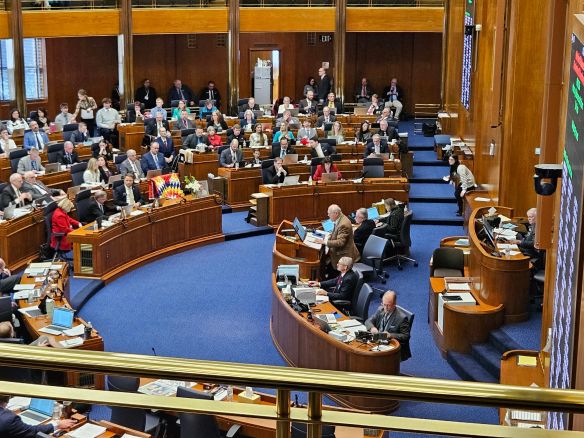
Lawmakers pushed through to wrap up their action on all bills at 4 a.m. Saturday morning. In the end, about 600 bills were passed a budget of $20.3 Billion. There were many hang-ups that drew out Day 74 Friday night and forced legislators to work into the early morning. In particular, a conference committee report on campaign finance was rejected, new conferees appointed, several additional meetings were held and after all that the Senate defeated HB 1377 – which was their final bill to act on. Before that, lawmakers gave final action on important budget bills and property tax relief.

PROPERTY TAX RELIEF

The Property Tax Relief bill, HB 1176, will provide more than triple the amount of relief to North Dakota property taxpayers. Governor Armstrong signed the bill into law Saturday which provides a primary residence credit of up to $1600. The $403 million in relief is funded by Legacy Fund earnings. HB 1176 was expected to be one of the first bills passed this session; but was finalized on the last day. The conference committee met 13 times, deadlocked over the provision that required taxpayers to pay at least 25% of their taxes due. That amendment was removed in the final version. Below are some highlights of what is included in the bill, click to View HB 1176.

  • RELIEF:
  • $1600 in property tax relief for primary residences, known as the PRC ($403 million total / biennium)
  • The Primary Residence Credit may not: reduce liability for special assessments, exceed the amount of taxes due on the primary residence
  • Increases renter refund to $600
  • Increases disabled veteran’s credit
  • Removed the expansion of homestead tax credit that was approved in prior versions
  • RESTRICTIONS:
  • Caps local government at 3% growth in dollars levied by property taxes
  • Political subdivisions can carry over unused percentage to use once within 5 years
  • Counties, cities & schools can go to a vote in general election to get approval to exceed 3% limitation, good for four years. Townships can vote at annual meetings to exceed cap.
  • ADMINISTRATION:
  • Creates primary residential property as new class of property
  • Assessment notices to all property owners and include date, time & location for local board of equalization meetings
  • Budget hearing notices to replace estimated tax notices
  • PRC can be applied to voter approved levies (this was a technical correction NDACo worked to get in final bill)
  • Interim study to look at implementation of HB 1176, impact of levy limitations, feasibility of revising tax statement & analysis of tax-exempt property

The House defeated HB 1168 which was another property tax relief bill still alive, and the Senate killed HB 1575 which also was still being held by the Senate as a backup vehicle in the event lawmakers ran into issues coming to an agreement on HB 1176.

TRANSPORTATION FUNDING

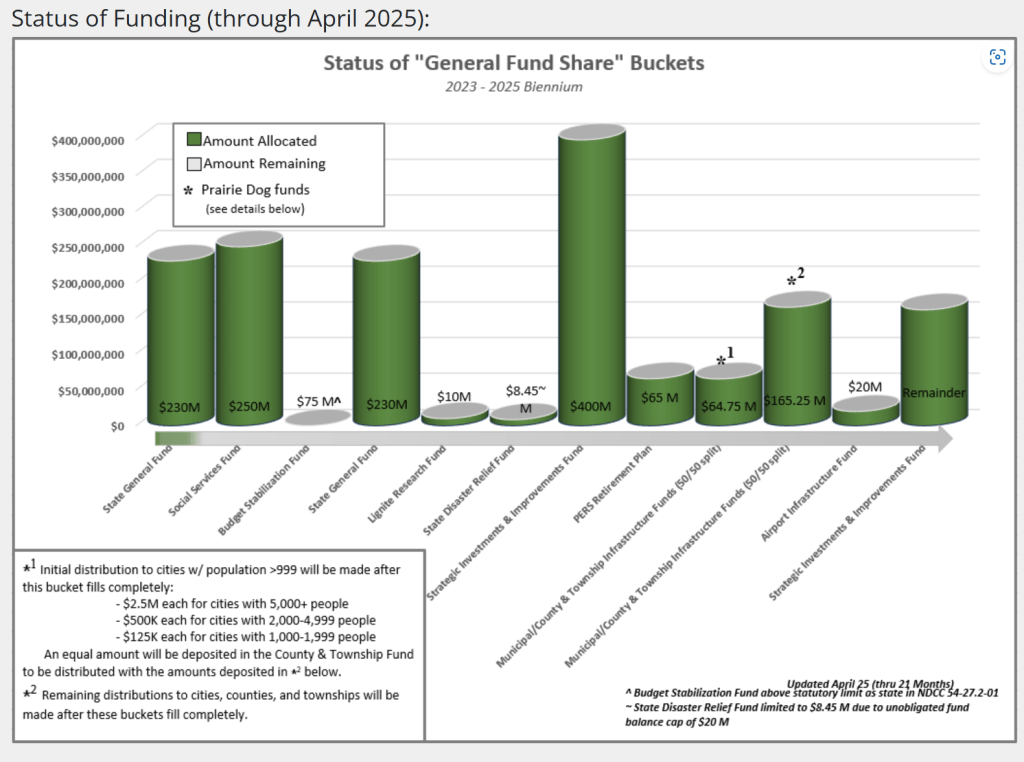
Major changes came late Friday on the NDDOT Budget SB 2012, which at initial analysis appear to be more favorable to local funding for roads. After negotiations, lawmakers settled on keeping the Prairie Dog buckets in the oil & gas revenue stream and in fact moved the buckets up ahead of the Strategic Investment Improvement Fund (SIIF) bucket. This provides more assurance Prairie Dog buckets will fill as these funds are dependent on oil prices and production. However, the Prairie Dog funding is decreased from $230 million to $160 million to cities, counties and townships. The survival of Prairie Dog may be a result in the direct message NDACo provided to lawmakers Wednesday urging lawmakers to resist the House proposal to eliminate the Prairie Dog funding. Here are other highlights of the DOT Budget:

  • Total DOT Budget $2.7B
  • Adjusts allocations of state share of oil & gas tax collections to municipal, county & township infrastructure funds (Prairie Dog)
  • 50% of Motor Vehicle Excise tax will go towards roads with 25% into highway tax distribution fund and 25% into the flexible transportation fund, the other 50% goes to the General Fund.
  • Adjusted the Highway Tax Distribution fund: 60% state, 35% counties/cities, 3.4% townships, 1.6% transits
  • No gas tax increase (House proposed 5-cent increase which would have raised $70 million in funding for infrastructure)

STATE HOSPITAL & PRISON EXPANSIONS

The OMB Budget, HB 1015, included $300 million for a new State Hospital to be built in Jamestown. It also included 3% salary increases for state employees for each year in the biennium. The bill also increased funding for guardianship grants.

SB 2015, the DOCR Budget includes several one-time appropriations as well to address the overcrowding of the prison system including: Funding to construct the Heart River Correctional Center (new women’s prison), temporary housing at the Missouri River Correctional Center and $20 million to plan and design a new minimum security male correctional facility. In addition, the budget includes an increase in the rate DOCR pays counties for housing state inmates from $110 to $115 a day. SB 2015 also includes a study related to sentencing practices, correctional and parole systems. This study was added following the defeat of SB 2128 which sought to increase sentences for violent crimes.

NDDHHS BUDGET

The ND Health and Human Services budget, HB1012, passed keeping State Aid funding for local public health units level at $8 million for the 2025-27 biennium. Also funded in the state’s largest budget were behavioral health facility grants: $1.5 million added to the previous biennium’s funding and matching funds for CHI Williston to complete 10 patient behavioral health beds by the end of calendar year 2025 along with $12.9 million one-time funding and matching funds to help in completion of 24 behavioral health beds at Altru Health in Grand Forks to serve the northeast region.

OTHER BILLS THAT RECEIVED FINAL ACTION

SB2267 was signed by Governor Armstrong surrounded by bill sponsors and supporters. The bill puts rule making and installer licensure for onsite wastewater treatment systems (septic systems) under the Department of Environmental Quality (DEQ). Permitting will continue to be done by local public health units with DEQ adopting rules and providing technical assistance and guidance as needed. Passage of this bill comes from years in the making over several sessions.

A conference committee removed a provision in HB 1022 to add $50 million to the infrastructure revolving fund for political subdivisions. This additional funding was added as a last attempt to provide financial assistance counties with jail expansions or new builds. Two other bills that sought to provide low interest loans or grants were defeated and the Legislature voted to study local jail needs instead.

  • HB 1454: Prohibits government entities from requiring vaccines – PASSED
  • HB 1298: Increases speed limit on interstate to 80 mph and changes speeding fine schedule – PASSED
  • HB 1229: Assumes vehicle owner is responsible in fleeing incidents, sets penalties – PASSED
  • SB 2180: Requirement for public comment at regular meetings (city, county, township, school district, park district, water resource district) – PASSED
  • SB 2093: House added income tax relief to Senate bill to provide income tax exemption for retired law enforcement benefits paid to surviving spouses – FAILED

Special thanks to all our county members who communicated with your lawmakers on bills. Your involvement makes all the difference!

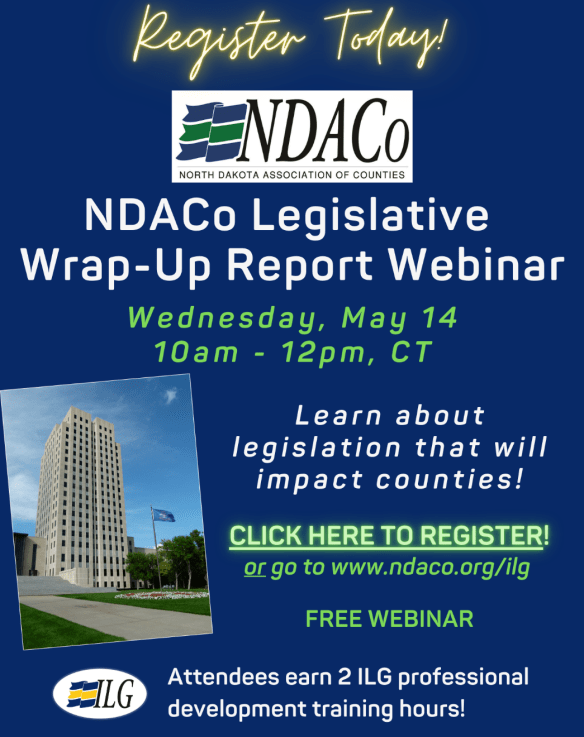
Stay tuned for a more detailed report summarizing the entire 69th Legislative Session and county-related bills. Make sure to register for the ND Legislative Wrap Up – May 14th!

ND COUNTIES URGE LEGISLATORS TO RESIST ELIMINATING PRAIRIE DOG FUNDING

*The following message was sent to ND Legislators in NDACo’s Common Ground. We encourage you to emphasize the importance of Prairie Dog funding for your county with your lawmakers.

The ND Department of Transportation budget is one of the most contentious bills being sorted out in conference committee as the Legislature finishes their work. There are huge differences between the House and Senate versions of SB 2012 regarding funding sources.

The House version revamps the funding system for local infrastructure which includes eliminating the Municipal, County/Township Infrastructure buckets commonly known as “Prairie Dog” in the state’s oil and gas revenue distribution. Instead, the House proposes to use Strategic Investments and Improvement Fund (SIIF) dollars to go to local infrastructure. This in turn eliminates $230 million in direct distribution dedicated to county, city and township infrastructure, opting instead to provide additional money based on grants from the DOT.

PRAIRIE DOG HAS PROVIDED STABLE AND DEDICATED FUNDING FOR POLITICAL SUBDIVISIONS

The Prairie Dog funding is a dedicated source of funding to counties, cities, and townships for important infrastructure projects. Counties and townships can use the funds for road and bridge projects associated with the construction of new unpaved and paved roads and bridges or associated with the maintenance, repair or replacement of existing unpaved and paved roads and bridges.

While Prairie Dog funds are not certain, and many lawmakers forecast the buckets won’t fully fill this biennium, it’s the fact that when these dollars are provided, they are committed to local government. NDACo continues to support efforts to move the Prairie Dog buckets up to increase the dependability of the buckets filling.

Another appeal of Prairie Dog funds is that they can be banked and used for major projects. This has proven to be an efficient way for local government to tackle large, expensive projects that in the past have been difficult to take on within limited budget authority. The dollars are distributed to counties based on road and bridge infrastructure needs as identified by the Upper Great Plains Transportation Institute.

The House proposal eliminates Prairie Dog funding that was established in 2019. It is one of the buckets created to distribute oil and gas production revenues with non-oil counties, cities and townships. Since inception, Prairie Dog has provided $460 million in funding with distributions being made in 2023 and 2025.

The proposal to eliminate Prairie Dog is a major policy shift that was devised and passed out of the House without a hearing, with no opportunity for input or time for political subdivisions to address concerns with the Appropriations Committee.

GRANTS vs DIRECT DISTRIBUTIONS

Direct distributions provide all political subdivisions monies that can be used for local priority projects as determined by elected officials the voters have approved. Grant dollars, while certainly helpful in many instances, also create uncertainty to the local political subdivision who then have to rely on another entity’s decision on the value of the project. Grants also create additional paperwork for the subdivisions which in many cases the subdivision has neither the time or expertise to handle.

MOTOR VEHICLE EXCISE TAX

NDACo is supportive of the use of Motor Vehicle Excise (MVE) tax for funding roads and bridges. In 2023 the Legislature approved 50% of the MVE tax to be one of the funding sources for the FLEX fund which generated $170 million a biennium. The Senate version of SB 2012 included 100% of the MVE to local infrastructure, while the House version moves 100% of the MVE tax to the General Fund.

GAS TAX

NDACo continues to support gas tax increases that are dedicated exclusively to road infrastructure. Earlier this Session the House passed a $.03 gas tax increase which would be the first increase in 20 years. The Senate proceeded to kill that bill (HB 1382) leaving significant questions about the viability of any gas tax increase. The House’s current plan for the DOT budget includes a $.05 gas tax increase to help cover the loss of Prairie Dog funds, which again inserts uncertainty into local road funding.

AVOID SACRIFICING TRUSTED FUNDING SOURCES

The ND Legislature revised the infrastructure funding plan in the 2023 Session. Counties urge lawmakers to let the current funding model plan work for another biennium. This is especially important with the proposal of a 3% cap on local government’s ability to raise taxes. This budget cap, which seems inevitable, goes into effect this year. This creates a lot of uncertainty with the ability to address funding local needs.

Bottom line: state funding for roads and bridges reduces local property tax dollars required to address needs.

Dependable and dedicated infrastructure funding for local roads and bridges is a top priority for NDACo. We understand this is a difficult time in the process, but we urge lawmakers to keep the funding stream of Prairie Dog intact. While Prairie Dog is uncertain in filling because it is dependent on oil prices and activity, it provides a source of dollars that is dedicated to address local road and bridge needs. We urge lawmakers to SAVE PRAIRIE DOG.  

Legislature Expected to Complete Work this Week

It’s the Legislature’s goal to end the session Friday, or work through the weekend until they do. Monday is day 71 of the 80-day limited Legislative Session. Lawmakers spent most of their days this week in conference committees working out the differences between the House and Senate versions of bills even meeting Saturday.

Legislators met six times on HB 1176, which is the property tax relief bill that also restricts local government’s ability to increase taxes. The conference committee started working off proposed amendments brought in by the House. Many of these amendments are pretty similar to what the Senate was working on to improve the property tax relief/reform package prior to the conference committee meeting, so it appears there aren’t many differences. Building off the version of the bill the House passed the amendments proposed would:

  • Increases the Primary Residence Credit to $1650
  • Use Legacy Earnings to fund the property tax relief
  • Includes changes to the disabled veterans’ credit by increasing the credit
  • Removes the proposed expansion of the homestead tax credit
  • Removes the provision stating that the PRC may not be applied to voter approved levies (this was a major priority for NDACo)
  • Removes language related to levy limitation and township levies (this was determined not to be needed as townships vote yearly on their budgets)
  • Adds an exemption to the levy limitation section related to borrowing
  • Includes intent language for the legislature to provide property tax relief to additional property classes in the future
  • Adds a study on various property tax relief and reform topics including the content on a tax statement
  • Appropriation: $438.2 million
HB 1176 Conference Committee

The bill still contains a 3% cap restricting the growth of tax levies for local government but allows the political subdivision the ability to exceed the cap with a vote during the general or primary election, emergency levies are also exempt from the cap. The committee discussions have been focused on the challenges related to capping school districts due to the current school funding formula. The Senate has also emphasized their support for a provision to ensure property owners are paying at least 25% of their tax liability. The 75% threshold may be the greatest difference at this point between the House and Senate stance on HB 1176.

The Senate also finally acted on HB 1168 which was introduced to provide property tax relief by buying down school mills. The Senate “hog-housed” the bill to mirror their changes to HB 1176 and passed it unanimously. Senate leaders have indicated they have kept the bill alive as a backup in the event the conference committee can’t agree on HB 1176. The Senate Finance & Tax committee has not acted on HB 1575 which is highly unusual at this point in the session. This property tax relief/reform bill sought to reduce property tax rates and restricted local government by capping taxable valuation growth.

TRANSPORTATION FUNDING

The House approved their version of the ND Department of Transportation budget which includes a drastically different proposal for infrastructure funding for counties, cities and townships. The House version includes a 5-cent increase in the gas tax which would generate $70 million. House members debated that portion of the bill separately, that aspect of the bill passed narrowly with a vote of 47-42. The House then moved to approve the entirety of SB 2012. The conference committee met for the first time on this bill Saturday. The greatest differences between the House and Senate versions are:

  • The House version eliminates the prairie dog buckets and instead includes that funding inside the SIIF bucket in the oil & gas tax distribution revenue streams.
  • The House version has all of the motor vehicle excise tax going to the General Fund. The Senate version has 100% of the MVE going to counties, cities & townships for road funding.
  • The House version has more focus on local dollars for infrastructure being distributed through grants versus direct distributions.

The Senate killed HB 1382 which proposed a 3-cent increase in gas tax with a vote of 0-45. Which may indicate that a gas tax increase may be difficult to get approved in SB 2012.

Other Conference Committees:

The DHHS budget, HB1012, conference committee has met seven times and is still reviewing changes made by the Senate. A few items have been agreed upon but there are still quite a few discussion points. Members on both sides are thoughtfully considering the differences.

The DOCR budget, SB 2015, is another big budget with funding for add prison space. It also includes an increase in the daily rate to county jails when NDDOCR contracts with them for beds.

Here is a link to the conference committee schedules which updates during the day:

https://www.ndlegis.gov/legend/committee/conference/public-schedule/

Bills worth noting that received final action this week:

  • HB 1193: Back the Blue Grants of $3.5 million to local law enforcement for retention bonuses – PASSED
  • SB 2180: Public Comment – PASSED
  • SB 2160: Related to NDPERS Health Insurance – PASSED
  • HB 1613: Law Enforcement use of Robots – PASSED
  • HB 1582: False information to Law Enforcement – PASSED
  • HB 1307: Prohibits home rule cities/counties from superseding state law on elections – PASSED
  • HB 1482: Requires bond elections to be on primary or general ballot – PASSED

Lawmakers Consider Major Changes to Road Funding & Property Tax Bills

Two actions took place this week that could prolong the work of the Legislature. With 15 days to go before lawmakers hit the maximum number of days allowed, there’s a lot of work yet to do and yet we are seeing a lot of maneuvers making significant changes to bills as committees finish their work on bills. Many of these concepts have come at a surprise, with no prior conversation in committee or during testimony.

PROPERTY TAXES

First, the Senate Finance and Tax Committee took up one of the property tax relief/reform bills still waiting to be acted on. HB 1168 as introduced would have provided relief through the school funding formula by the state buying down additional school mills, it also capped local governments from increasing their levies by 3%. The Senate committee amended the bill moving to providing the relief utilizing the primary residence credit and increasing that amount to $1,650. HB 1168 now looks very similar to HB 1176. In addition, the committee made improvements to HB 1168 by addressing some technical concerns NDACo had with HB 1176. One of those amendments to HB 1168 now allows the primary residence credit to be applied to all taxes owed including voter approved levies as well as includes a provision that the credit can cover a max of 75% of the property taxes owed up to $1650 and minimum of $500. The Senate approved the amendment to HB 1168; Senate Appropriations will hear the bill early next week. It is uncertain at this time what the strategy is to have two nearly identical property tax bills still in the mix.

Meanwhile, the conference committees have been appointed for HB 1176. Representatives Headland, Bosch & Nathe along with Senators Weber, Bekkedahl & Erberle. These lawmakers will meet next week to go over the differences between the House and Senate versions of HB 1176 and try to come to a compromise.

ROAD FUNDING

A number of amendments were brought forward in SB 2012, the NDDOT Budget, that would restructure local road funding sources. These changes were discussed in the House Appropriations Government Operations sub-committee and will be forwarded to the full House Appropriations committee for their consideration. These amendments are a substantial change from the version of the bill as it was approved by the Senate. Some of the greatest changes proposed through the amendment would eliminate prairie dog buckets in the oil & gas revenue buckets and instead allocate funds for local roads in the SIIF bucket. The amendment also proposes a 5 cent gas tax increase. While this proposal could provide additional funds and greater certainty for local funding; the downside could be the loss of local control in determining how these dollars should be used as a great percentage of the local dollars would be allocated through a grant process. Again, lawmakers will have further opportunities to make changes to this amendment. Here is a summary of the amendment:

  • Transfer $370M from SIIF to Flex Transportation Fund
    • Adding the use of these funds for “other infrastructure” in addition to road and bridge projects, so water/sewer projects for cities can be included for use of these funds
    • $159.1M is allocated for grants to counties, cities and townships in non-oil producing counties for road and bridge projects
    • $49.9M is allocated for grants to eligible counties for bridges/bridge maintenance
    • $42.5M is allocated for county formula distribution (same for cities)
    • $25.9M is allocated for township formula distribution
    • Non-oil producing county is defined as county that had average annual oil production of fewer than 10 million barrels (based on avg over a 3 year period)
  • Removing Prairie Dog Bucket and including funding in the SIIF Bucket
  • Under the Highway Tax Distribution Fund (direct distribution):
    • $205.9 distributed to counties/cities
    • $20M distributed to townships
  • 100% of Motor Vehicle Excise Tax would be returned to the State’s General Fund
  • Proposing a $0.05 fuel tax increase which would generate an additional $70M
  • Proposing to bond the Hwy 85 Project of $155M

There is also a proposed amendment for additional criteria in the Flex Fund selection process to consider projects in counties, cities and townships that have a zoning ordinance or policy that are more restrictive than the state in the areas of agriculture or energy.

The Senate Finance & Tax Committee amended HB 1382 which seeks to increase the gas tax 3 cents to strike out the language that limited the funding to non-oil counties, so the share of the gas tax increase would go to all counties, cities and townships.

OTHER NOTABLE BILLS

  • HB 1193: Back the Blue grants – $3.5 m to local law enforcement for retention bonuses. PASSED Senate – expect House to Concur.
  • HB 1197: Study of jail infrastructure needs – FINAL Passage.
  • HB 1361: Maximum penalties for Human Trafficking offenses – FINAL passage
  • HB 1482: Requires bond elections to be on primary or general election, still includes a 60% threshold vote approval. PASSED Senate – expect to go to Conference Committee.
  • HB 1298: Increases speed limit on interstate to 80 mph & changes speeding fees and point system. PASSED Senate.
  • HB 1053: Repeals limitation that restricted DOT from adding road miles on state highway system – FINAL Passage
  • The Senate concurred with House amendments to SB2267 putting septic system authority under DEQ while retaining inspections and permitting at the local level.
  • HB1577 was introduced to address the more than 300 ND communities identified as having wastewater and stormwater needs by DEQ. This bill establishes a wastewater infrastructure grant program and consideration of a legislative management study to explore funding sources. Responding to a sudden loss of Federal funding grants already awarded, the Senate Appropriations Committee amended the bill authorizing BND to provide a line of credit. This is considered one-time funding and passed the Senate floor with an emergency clause attached.
  • HB 1588: Related to where possess weapons. Public buildings amended out of bill. FINAL Passage
  • HB 1591: $1.5 million grant for county fairs – FINAL Passage

DHHS BUDGET

The DHHS budget bill, HB1012, passed on the Senate floor as amended by the Senate Appropriations committee. The state’s largest budget includes funding from general funds, SIIF, CHTF (Community Health Trust Fund) and Federal funds. Some of the notable changes made from the House budget are:

  • $5M from SIIF for a behavioral health facility in Grand Forks revised from the $12.96M House allocation
  • $4.4M one-time funding from the community health trust fund for a licensed intermediate care facility in the south central human service region to provide services to children or young adults with medically and behaviorally complex conditions
  • $585,000 general funds for crisis service grants serving young adults at risk of homelessness or experiencing other serious adverse life events; this reflects the same amount in the last biennium and was added on the Senate side
  • Since construction for a new Community Cultural Center facility supporting Native American heritage will not ready this biennium, the Senate replaced $1M for the facility with $300,000 for a cultural program
  • $500,000 reduced from $750,000 in the House for one-time funding from the community health trust fund for juvenile justice diversion services and programs
  • $750,000 Statewide Health Strategies from CHTF removed

WHAT TO EXPECT FOR NEXT WEEK

Legislative leadership provided insight on the budget and remaining bills in closing comments this week:

  • Currently, proposed bills are overspending in General Fund by $300 million and the SIIF by $200-$300 million
  • Appropriations committees are looking for budget reductions
  • There are 170 bills left to decide with 50 bills in conference committee
  • Multiple floor sessions a day, starting at 8 a.m. Monday
  • Conference Committees will meet several times a day at any time floor sessions are not scheduled.

Click to view a list of scheduled bills that have committee work or conference committee meetings. This list automatically updates multiple times a day.

Click to view a list of the high priority NDACo bills still active.

Conference Committee Activity to Ramp Up this Week

Monday marks day 61 of the Legislative Session that is limited to 80 days. Legislative leadership has indicated their goal is to wrap up their work by the end of the month. Very few bills remain in policy committees and appropriations committees are completing their work on budget bills. The shift this week into conference committee mode will be very noticeable. This is where the differences are worked out in bills passed by the House and Senate. At this point in the process, the schedule is fluid, and not much advance notice is provided for when conference committees meet. The best way to stay on top of the schedule is to follow the NDACo bill tracking link which updates multiple times a day. Click here to view the NDACo Bill Tracking Schedule.

Property Tax Relief / Reform

We anticipate the major property tax relief/reform bill, HB 1176, will have movement this week. The Senate made significant changes to the bill including reducing the amount of relief from $1450 to $1250. The House is expected to not concur with the change and appoint a conference committee early this week. A conference committee will more than likely meet this week. NDACo has met with House and Senate members on suggested technical changes to the bill. One of the changes we would like to see includes removing the exclusion of the primary residence credit from voter approved levies. The Senate Finance and Tax Committee continues to sit on two other property tax relief/reform bills (HB 1168 & HB 1575).

Septic System Bill Progress

The Senate defeated HB1541 which included a hefty fiscal note from the Department of Environmental Quality (DEQ) for additional duties. DEQ estimated two full-time equivalent (FTE) positions would be needed to adopt rules regarding the licensing, permitting, and inspections of sewer, septic and private water system. The House Energy and Natural Resources Committee gave a Do Pass recommendation on SB 2267 after adopting amendments that largely mirrored language from HB 1541. Additionally, the fiscal note from HB 1541 was removed and instead included a one-time appropriation to defray costs incurred by DEQ for program implementation. Committees in both Chambers recognize the importance of passing a bill to address this multi-session issue.

Priority Bills to Watch this Week

Click to view list of NDACo Priority bills that are still active

  • HB 1176 – Property Tax Relief / Reform – Conference Committee
  • HB 1168 – Property Tax Relief / Reform – Senate Tax
  • HB 1575 – Property Tax Relief / Reform – Senate Tax
  • HB 1382 – Gas tax increase for roads – Senate Tax
  • SB 2015 – DOCR Budget – House Appropriations
  • SB 2012 – DOT Budget – House Appropriations
  • HB 1012 – DHHS Budget – Senate Appropriations
  • HB 1193 – Back the Blue grants – Vote in Senate possibly Tuesday
  • HB 1015 – OMB Budget includes additional Prairie Dog buckets
  • HB 1482 – Bond elections for cities, counties and schools to take place during Primary or General Election. DP in Senate Tax – vote on Senate floor.
  • HB 1534 – 3% cap on property values for taxation purposes. DNP recommendation in Senate Tax – goes to Senate for vote.

Public Safety Bills

  • HB 1003: Attorney General budget – The Senate approved including language prohibiting Judges from waiving 24/7 fees. This is identical language as what was in SB 2365 that was defeated. The bill is likely to head to conference committee.
  • HB 1225: Increases penalty for reckless endangerment crimes with a firearm – PASSED Senate
  • HB 1596: Decriminalized small amounts of marijuana – FAILED in Senate
  • HB 1419: Allows 911 dispatchers & EMS to enroll in public safety NDPERS plan if offered by political subdivision. FINAL PASSAGE
  • HB 1197: Study infrastructure needs of county and regional jail facilities. Bill was introduced as $50 million in jail improvement grants – FINAL PASSAGE
  • HB 1375: Related to fake ID’s and the penalty. FINAL PASSAGE
  • HB 1613: Use of Robots by law enforcement. Amended to address law enforcement concerns. PASSED Senate – returns to House for review.

Other Bills Worth Noting

  • HB 1259: Eliminate Daylight Savings time – FAILED
  • HB 1387: Schools required to be closed if polling place on Election Day – FAILED
  • HB 1297: Prohibits rank choice voting – PASSED Senate
  • HCR 3003 – Increases threshold for votes needed to change state constitution measures to 60% – PASSED Senate

Senate Reduces Property Tax Relief Plan

The big headline of the week is the Senate’s action on HB 1176, one of the major property tax relief bills. The Senate on Thursday approved an amended version of HB 1176 that reduced the amount of property tax relief for primary residences from $1,450 to $1,250. The Senate’s objective for lowering the relief is to pay for it using Legacy Fund earnings and no General Fund dollars. Amendments also included a provision that limits the credit to cover no more than 75% of the taxpayer’s liability but provides a baseline credit of $500. The bill expands those eligible for the homestead credit and increases the renter’s credit. On the reform side of the bill, restrictions in HB 1176 stayed the same. Local governments are capped at a 3% growth on the dollars they can levy. However, the bill allows local governments to carry over unused caps, exempts emergency levies and allows voters to approve exceeding the cap for up to four years. The Senate approved HB 1176 47-0.

Because of the difference in the Senate and House versions of HB 1176, it is highly anticipated the House will Not Concur with the Senate’s changes. If that happens, a conference committee of three members from both the House and Senate will meet to work on a compromise version. NDACo has identified some technical corrections that need to be made to the bill that will prioritize to be addressed in conference committee. We expect the conference committee to be appointed and more than likely meet this week.

In the meantime, the Senate Finance & Tax committee is still sitting on three of the property tax relief/reform bills (HB 1168, HB 1575 & HB 1534). The committee is scheduled for committee work Monday-Wednesday.

The House on Thursday spent nearly two hours debating SB 2128 the Attorney General’s Truth in Sentencing bill, which was drastically amended and then defeated with a vote of 41-52. The bill required violent offenders, drug traffickers and sex offenders to serve at least 50% of their sentence.

Other bills that saw action this week:

  • HB 1572 – Included study language on tax statements – Senate Defeated
  • HB 1588 – Related to where can carry firearms, as introduced the bill would have allowed firearms in public buildings but was amended to restrict the possession as it is currently in code. Senate Passed.
  • HB 1340 – Increases the amount of window tint allowed in front vehicle driver & passenger windows. Supporters showed up in sunglasses for the bill signing. Signed by Governor Armstrong.

The schedule for bills scheduled for hearings and conference committees can be viewed/downloaded here. Reminder that the schedule updates so it will change as conference committees or appropriations hearings are scheduled.

Weekly Update for March 24-28th

There is great anticipation this week in watching what happens next with HB 1176. That’s the property tax relief bill sponsored by Rep. Nathe and touted by Governor Armstrong to increase the primary residence credit which also caps local government. The Senate Appropriations committee amended the bill Thursday afternoon. They adopted amendments to reduce the primary residence credit to $1250 and limiting the credit to cover no more than 75% of a taxpayer’s liability. This amendment was pitched to ensure taxpayers are paying for some of the local services they receive. The other amendment approved provides intent for relief to be expanded to other taxpaying classes next session. Four other amendments were discussed but failed including a 2% cap for larger cities and counties and eliminating the ability to vote to exceed the cap until 2028.
What’s next: The amendments will be voted on in the Senate possibly Tuesday and then if the amendments are approved, the bill in its entirety will be voted on the next day. Because the bill has changed since coming over from the House. It is highly likely HB 1176 will go to conference committee where three members of each the House and Senate will work out differences.

Several other tax bills are still sitting in the Senate Finance & Tax Committee. We anticipate they will work on these bills this week and are also waiting to see how HB 1176 progresses. Of those bills, HB 1168 buys down school mills to provide relief and also caps local government and HB 1575 reduces the tax rate for property classes and caps taxable valuation.

Transportation Related

HB 1382, which seeks to increase the gas tax 3 cents for counties, cities & townships was heard. Rep. Hagert proposed an amendment to expand the funding to all, not just non-oil producing. The bill will provide $42M per biennium in funding broke out as follows: $18M for counties, $10M cities and $14M for townships. 

House Appropriations continues to work on the NDDOT budget SB 2012 which also includes local road funding by using 100% of the motor vehicle excise tax, legacy earnings fund and Flex Transportation Fund.

Law Enforcement Related

  • SB 2128 which is the Attorney General’s Truth in Sentencing bill had a long hearing Monday. The committee heard from the Attorney General, State’s Attorneys and law enforcement in support of the bill. The committee did not discuss or take action on the bill.
  • HB 1193 provides $3.5 million to local law enforcement & corrections officers for recruitment and retention bonuses was given a Do Pass recommendation from the Senate Workforce & Development Committee. The bill has been referred to Appropriations.
  • Two bills introduced to provide assistance to counties for jail improvements have been stripped. HB 1213 was defeated in the Senate (20-27) after being amended in Appropriations to include $20 million in additional infrastructure revolving loan funds. HB 1197 was amended in the House into a study of jail needs, attempts to return the bill back to its original purpose as a grant for jails were unsuccessful.

Public Health Related

Although septic system bills are still being considered in committee, SB2308 placing the onsite wastewater recycling technical review committee under DEQ passed the House. HB1541 was amended in Senate Ag & Veterans Affairs to eliminate advisory committee language based on the efforts to limit state boards and committees. The committee is holding this bill pending status of related SB2267 being reviewed in House Energy and Natural Resources. Legislators agree that a bill addressing this multi-session issue is needed and are working together for resolution.

  • HB1114 capping out-of-pocket insulin at $25 passed both chambers
  • The Senate passed an amendment to HB1454 exempting local public health units and human services zones from an opt-out procedure for required vaccines. The bill is on the Senate floor calendar for passage as amended.
  • HB1391 failed 17-29 on the Senate floor after rejecting a floor amendment. This bill would have created a new protected class status. GNDC and North Dakota Student Association were among those in opposition with health care systems and providers.
  • A legislative management study regarding limiting the release of self-spreading viruses and bacteria, HB1458, was also defeated in the Senate.
  • A motion to reconsider failed SB2105 relating to school surveys was defeated.
  • The House did not concur with Senate changes to HB1440 and now moves to conference committee.

Many committees have wrapped up hearing bills assigned to their committee and will shift to working on those bills and taking action to get them out of committee. Click here to see the schedule of bills being heard the week of March 31st.

Senate Appropriations Votes to Reduce Property Tax Relief in HB 1176

The Senate Appropriations Committee held committee work on HB 1176 Thursday afternoon. HB 1176 is the property tax relief bill that includes a $1450 primary residence credit and caps local government from increasing the dollars they levy by 3%, it does allow political subs to exceed the cap with a majority vote.

Senate Majority Leader David Hogue and Senator Mark Weber brought five amendments forward for the committee to consider. Senator Tim Mathern also proposed an amendment. Two of the six were approved and are now included in HB 1176.

  1. Primary Residence Credit is limited to no more than 75% of a taxpayer’s tax bill. Maximum relief is reduced to $1,250 and the credit may not be less than $500 as long as $500 or more is owed. Motion to Approve – PASSED
  2. Legislative intent the 2027 Legislative Assembly should provide relief to additional property taxpayers. Motion to Approve – PASSED
  3. Strengthens cap to 2% in 2025 for counties and park districts with populations over 20,000 (8 counties) and cities over 10,000 for year. Motion to Approve – FAILED
  4. Eliminated ability for political subdivisions to vote to exceed the cap until 2028 primary or general election. Motion to Approve – FAILED
  5. Allows townships to levy up to 36 mills without a cap. Motion to Approve – FAILED
  6. Senator Mathern proposed an amendment to eliminate the caps in HB 1176. Motion to Approve – FAILED

Next Steps: HB 1176 now includes the amendments (1 & 2 listed above). The Senate is expected to vote on the amendments Monday and if those amendments are approved the bill in its entirety could be voted on Tuesday. Because the Senate changed the House bill, the House can decide to not accept the Senate’s changes and move the bill to a conference committee to work out the differences. In other words, this bill is far from being done.

The Senate also has several other property tax relief bills that include restrictions for local government that remain in the Senate Finance & Tax committee. It is unknown when they will be acting on those bills.